


Virginia Tech Molecular Diagnostics Lab
ADVANCING PRECISION ONCOLOGY
VIRGINIA TECH
MOLECULAR DIAGNOSTICS LAB
Advanced cancer genomics for Southwest Virginia and beyond.
The Molecular Diagnostics Laboratory at the Fralin Biomedical Research Institute is a CLIA-certified, CAP-accredited academic laboratory focused on the molecular characterization of cancer. Clinical testing, assay validation, and translational research operate within a single institutional structure and in coordination with regional healthcare partners.
A regional academic laboratory for cancer molecular diagnostics
The laboratory integrates advanced genomic technologies, analytical rigor, and collaborative expertise to expand access to molecular characterization of cancer and support precision oncology research. Clinical molecular diagnostics, assay development and validation, and translational research are pursued within a single institutional structure.
- Clinical Testing ↗ Analytically validated, clinically reportable molecular diagnostic testing under CLIA and CAP oversight.
- Assay Development and Validation ↗ Design, analytical validation, and implementation of laboratory-developed tests within the CLIA framework.
- Research and Collaboration ↗ Research-use platforms and collaboration pathways for cancer genomics, biomarker studies, and method development.


Genomic Capabilities
The laboratory addresses multiple classes of genomic alteration in cancer through targeted next-generation sequencing, digital PCR, and, in a research-use context, long-read sequencing.
Alteration classes
- Single-nucleotide variants (SNVs)
- Small insertions and deletions (indels)
- Copy-number alterations (CNAs)
- Gene fusions
- Structural variants
- Microsatellite instability (MSI)*
- Tumor mutational burden (TMB)*
Clinically reportable The Oncomine Myeloid Assay is analytically validated and clinically reportable. Results carry clinical significance in myeloid malignancies as interpreted by the treating clinician.
Under analytical validation The Oncomine Comprehensive Assay Plus is under analytical validation and is not currently clinically reportable.
Research-use platforms Long-read sequencing on the Oxford Nanopore GridION and biomolecular interaction analysis on the Biacore 3000 are used in a research-use context and do not generate clinical reports.
* MSI and TMB are calculable from broad-panel sequencing. Their inclusion in the clinical menu is contingent on completion of validation of the corresponding assay.


The laboratory holds accreditation under the CAP Laboratory Accreditation Program
Accreditation applies to the laboratory as a testing entity and does not, in itself, endorse any specific assay. Individual clinical assays are made available only after in-house analytical validation.

An academic molecular diagnostics laboratory located within the region shortens the geographic distance between specimen and analysis and situates molecular characterization within the same clinical and research community it serves.

Translational cancer genomics. Research-use characterization of tumor genomes, including long-read sequencing of structural variants and biomolecular interaction studies.
Implementation science. Studies of how molecular diagnostic testing is incorporated into clinical workflows in regional healthcare.
Research-use activities are governed separately from clinical testing operations and do not enter clinical care.
LEADERSHIP
-
Bio Item
 Carla Finkielstein, Ph.D. , bio
Scientific Director
-
Bio Item
 Douglas Grider, M.D. , bio
Medical Director
ㅤ
-
Article Item
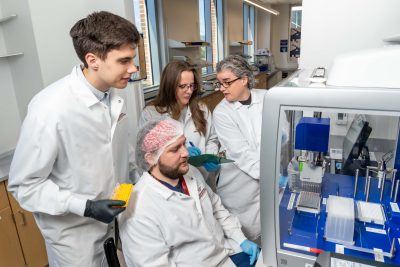 AI-backed saliva test shows promise for flagging chemotherapy risk, early results indicate , article
Fralin Biomedical Research Institute at VTC scientists developed a saliva-based artificial intelligence screening method that could flag patients at risk for dangerous side effects from a widely used chemotherapy drug.
Date: Apr 22, 2025 - -
Article Item
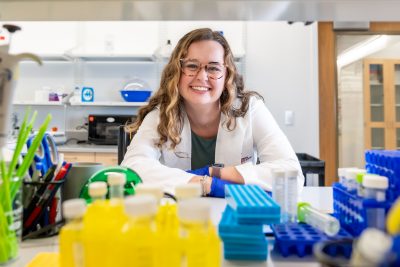 Translational biology, medicine, and health student pursues science close to home with new grant , article
Mason Wheeler, a doctoral candidate in the Pfleger Lab at the Fralin Biomedical Research Institute at VTC, earned a prestigious Ruth Kirschstein Predoctoral Fellowship from the National Heart, Lung, and Blood Institute, part of the National Institutes of Health.
Date: Oct 31, 2024 - -
Article Item
 The virus that causes COVID-19 is widespread in wildlife, Virginia Tech scientists find , article
Six of 23 common wildlife species showed signs of SARS-CoV-2 infections in an examination of animals in Virginia, as revealed by tracking the virus’s genetic code.
Date: Jul 29, 2024 -
-
Article ItemInterdisciplinary team receives $5 million grant to explore COVID-19 virus ecology at the human-animal interface , article
Virginia Tech researchers will explore the risk of SARS-CoV-2, the virus that causes COVID-19, infections in wildlife communities and how those risks could affect humans.
Date: Oct 20, 2023 - -
Article ItemFralin Biomedical Research Institute researchers take on public health challenge of hepatitis C , article
The institute’s Molecular Diagnostics Laboratory will lead efforts to provide genomic sequencing to help decrease spread of the virus that can cause liver damage.
Date: Oct 09, 2023 - -
Article ItemCarla Finkielstein named Roger H. Moore and Mojdeh Khatam-Moore Dean’s Faculty Fellow , article
A member of the Virginia Tech faculty since 2005, Finkielstein currently serves as the associate director of research of the Academy of Integrated Science in the College of Science and as interim co-director of the Virginia Tech Cancer Research Alliance.
Date: Sep 29, 2023 - -
Article ItemVirginia Cooperative Extension agents to be trusted messengers for COVID-19 vaccine information , article
A group of Virginia Tech researchers, along with partners at Virginia State University, are working to deliver facts about the COVID-19 vaccine to the hesitant in rural Virginia via messengers they know and trust: Virginia Cooperative Extension agents.
Date: Sep 22, 2021 - -
Article ItemSummer interns gain hands-on learning in Virginia Tech’s COVID-19 testing lab , article
During two five-week, hands-on sessions, the interns worked in the Molecular Diagnostics Lab at the Fralin Biomedical Research Institute at VTC and took classes led by Carla Finkielstein, the lab’s scientific director and an associate professor at the research institute.
Date: Jul 23, 2021 - -
Article ItemVirginia Tech’s COVID-19 testing operation demonstrates the power and versatility of academic labs , article
In the early days of the pandemic, scientists at Virginia Tech created a COVID-19 testing laboratory and novel test for the virus from scratch. This novel protocol for transforming a research laboratory into a COVID-19 testing operation was described in a new article published July 20 in Nature Communications.
Date: Jul 20, 2021 - -
Article ItemVirginia Tech COVID-19 lab passes 100,000-sample milestone , article
Since opening, the Molecular Diagnostics Lab has analyzed thousands of samples from Virginia Tech students and employees who were tested for the COVID-19 virus through the university’s testing centers. That’s in addition to testing done for regional health districts since April 20, 2020.
Date: Apr 05, 2021 - -
Article ItemCarla Finkielstein honored with Ut Prosim Scholar Award , article
Finkielstein, an associate professor of biological sciences in the College of Science and an award-winning cancer researcher, anticipated the limitations of existing methods for testing the novel coronavirus and enlisted a team to develop an innovative method that would more accurately, reliably, and rapidly detect the virus and help mitigate its spread.
Date: Mar 22, 2021 - -
Article ItemVirginia Tech COVID-19 lab ready to ramp up testing for thousands of student samples , article
Virginia Tech’s COVID-19 Molecular Diagnostics Laboratory, located at the Fralin Biomedical Research Institute at VTC, has processed more than 70,000 samples to support health districts across Virginia and the university community since its launch in April.
Date: Jan 13, 2021 - -
Article ItemVirginia Tech lab joins network to expand COVID-19 testing across state , article
Virginia Tech was selected as one of three exclusive OneLab Network Tier 2 laboratories to expand COVID-19 testing capacity across Virginia, Governor Ralph Northam announced on Nov. 10.
Date: Nov 10, 2020 - -
Article ItemVirginia Tech scientists, engineers to talk about steps to stop cancer in virtual public session , article
A year ago, Virginia Tech united its biomedical and technical expertise into a Cancer Research Alliance to take on the second leading cause of death in the United States. Now, scientists and engineers will talk about some leading-edge projects in breast cancer, brain cancer, and noninvasive cancer treatments in a public Zoom discussion at 7 p.m. on Tuesday, Nov. 10.
Date: Nov 02, 2020 - -
Article ItemScientists, engineers to discuss COVID-19 response in virtual HokieTalk on Wednesday , article
When the novel coronavirus hit the United States in January, Virginia Tech faculty recognized the nation was on the brink of a COVID-19 pandemic that would affect the university and the entire Commonwealth of Virginia. Hear the inside story about what happened during a virtual HokieTalk at 7 p.m. Wednesday, Sept. 30.
Date: Sep 27, 2020 - -
Article ItemVirginia Tech COVID-19 lab ready to test thousands of student samples , article
Starting this week, as students begin to return to campus for the fall semester, the lab’s capacity of 1,000 tests per day will also be dedicated to Virginia Tech students and employees in high-contact roles.
Date: Aug 09, 2020 - -
Article ItemVirginia Tech cancer researcher Carla Finkielstein to join Fralin Biomedical Research Institute at VTC , article
Finkielstein, a molecular biologist and an associate professor in the College of Science, will join the Fralin Biomedical Research Institute at VTC on July 1. Her laboratory, which studies how circadian rhythms are involved in breast cancer progression, will move to the Health Sciences and Technology Campus in Roanoke.
Date: Jun 23, 2020 - -
Article ItemVirginia Tech researchers develop new COVID-19 tests to combat backlogs, shortages , article
Virginia Tech scientists have developed a new COVID-19 test and secured federal and state approvals to immediately begin processing samples at on-campus labs in Blacksburg and Roanoke.
Date: Apr 22, 2020 -
Contact Us
Sarah Stern
General Supervisor
Virginia Tech Molecular Diagnostic Lab
sterns@vt.edu
540-526-2630